
Assessing avifaunal diversity and anthropogenic impacts on Ladhwaya Pond, Gwalior, India
DOI:
https://doi.org/10.11609/jott.9922.18.4.28673-28680Keywords:
Anthropogenic disturbance, aquatic avifauna, conservation, diversity, ecological role, habitat quality, rural ponds, small wetlands, village pond, wetland birdsAbstract
Village ponds serve as important micro-wetland habitats that support diverse avifauna yet are subject to anthropogenic pressures. The present study assessed the avifaunal diversity and seasonal variations in Ladhwaya Pond, Tekanpur, Gwalior (Madhya Pradesh), India, during 2024–2025 using point count and line transect methods. A total of 52 bird species belonging to 33 families and 17 orders were recorded, comprising resident and migratory species. Passeriformes was the dominant order, followed by Columbiformes and Charadriiformes. Diversity indices revealed the highest species diversity during winter (ShannonWiener H’ = 1.563; Simpson index = 0.826), indicating the pond’s seasonal importance as a refuge for migratory and water-dependent birds. Most species (98.1%) were categorized as ‘Least Concern’, while one ‘Near Threatened’ species, the Asian Woolly-necked Stork was documented, emphasizing the conservation value. Field observation indicated that grazing, unregulated fishing, agricultural runoff, and human disturbance significantly influenced habitat quality and bird assemblages, favouring disturbance-tolerant generalist species over sensitive taxa. The study highlights the ecological role of small rural wetlands in sustaining local and migratory bird populations and underscores the urgent need for habitat restoration, disturbance regulation, and community-based conservation measures to maintain avifaunal diversity in such anthropogenically pressured pond ecosystems.
References
Aarif, K.M., A. Nefla, K.A. Rubeena, Y. Xu, Z. Bouragaoui, M. Nasser, C.T. Shifa, T.R. Athira, K. Jishnu, J. Anand, S. Manokaran, P. Moosa, A. Gopinath, O.R. Reshi, H. Byju Rajaneesh, T.V. Joydas, K.P. Manikandan, M.I. Naikoo, C. Sonne & S.B. Muzaffar (2025). Assessing environmental change and population declines of large wading birds in south-western, India. Environmental and Sustainability Indicators 25: 100572. https://doi.org/10.1016/j.indic.2024.100572
Anand, J., H. Byju, A. Nefla, S. Abhijith, O.R. Reshi & K.M. Aarif (2023). Conservation significance of Changaram wetlands—a key wintering site for migratory shorebirds and other waterbirds in the western coast of Kerala, India. Journal of Threatened Taxa 15(1): 22410–22418. https://doi.org/10.11609/jott.8089.15.1.22410-22418
Archana, T.R., A. Nefla, H. Byju, S. Almaroofi, O.R. Reshi, A. S. Alatawi & K. M. Aarif (2024). Effects of plant and avian frugivore interaction networks on landscape patterns and seed dispersal functions in the southern Western Ghats, India. Ornithological Science 23(1): 35–43. https://doi.org/10.2326/osj.23.35
Bibby C.J., M. Jones & S. Marsden (2000). Expedition Field Techniques: Bird Surveys. Royal Geographical Society, London, 134 pp.
Birdlife International (2022). State of the World’s Birds 2022: Insights and Solutions for the Biodiversity Crisis. Cambridge, UK.
Boora, V. & P. (2023). Avifaunal diversity in unprotected rural wetland: Records from Kurukshetra, Haryana, India. Environmental and Ecology 41(2): 781–791.
Brusatte, S.L., J.K. O’Connor & E.D. Jarvis (2015). The origin and diversification of birds. Current Biology 25(19): 888–898.
Byju, H., K.A. Rubeena, C.T. Shifa, T.R. Athira, K. Jishnu, J. Singh, A. Sohil, S. Kumar, A. Kushwah, J. Anand & K.M. Rajaneesh (2023a). Transitioning wintering shorebirds to agroecosystem: a thorough evaluation of habitat selection and conservation concern. Diversity 16: 23. https://doi.org/10.3390/d16010023
Byju, H., N. Raveendran, S. Ravichandran & R. Vijayan (2023b). A checklist of the avifauna of Samanatham tank, Madurai, Tamil Nadu, India. Journal of Threatened Taxa 15(9): 23857–23869. https://doi.org/10.11609/jott.8419.15.9.23857-23869
Byju, H., H. Maitreyi, S. Ravichandran & N. Raveendran (2024a). Avifaunal diversity and conservation significance of coastal ecosystems on Rameswaram Island, Tamil Nadu, India. Journal of Threatened Taxa 16(12): 26198–26212. https://doi.org/10.11609/jott.9248.16.12.26198-26212
Byju, H., H. Maitreyi, N. Raveendran & R. Vijayan (2024b). Avifaunal diversity assessment and conservation significance of Therthangal Bird Sanctuary, Ramanathapuram, Tamil Nadu: insights about breeding waterbirds. Journal of Threatened Taxa 16(9): 25802–25815. https://doi.org/10.11609/jott.8999.16.9.25802-25815
Byju, H., H. Maitreyi, R. Natarajan, R. Vijayan & B.A.V. Maran (2025a). The avifauna of Ramanathapuram, Tamil Nadu, along the southeast coast of India: waterbird assessments and conservation implications across key sanctuaries and Ramsar sites. Peer J 13: e18899. https://doi.org/10.7717/peerj.18899
Byju, H., H Maitreyi, K.M. Aarif & N. Raveendran (2025b). Disappearing colonies: temporal decline in abundance and nesting of water birds in a key Indian wetland. Wetlands Ecology and Management 33:47. https://doi.org/10.1007/s11273-025-10067-y
Byju, H., H. Maitreyi & S. Ravichandran (2025c). Temporal dynamics of shorebird assemblages in Valinokkam Lagoon, Southeast India: A new wintering site along the Central Asian Flyway. Ornis Hungarica 33(2): 22–42. https://doi.org/10.2478/orhu-2025-0018
Byju, H., H. Maitreyi, K.M. Aarif, K.A. Rubeena & S. Ravichandran (2025d). Temporal patterns in shorebird diversity and abundance at Dhanushkodi Lagoon: a critical wintering ground along India’s southeast coast. Thalassas 41: 151. https://doi.org/10.1007/s41208-025-00908-1
Davidson, N.C. (2014). How much wetland has the world lost? Long-term and recent trends in global wetland area. Marine and Freshwater Research 65(10): 936–941.
Finlayson, C. M., M. Everard, K. Irvine, R.J. McInnes, B.A. Middleton, A.A. Van-Dam & N.C. Davidson (2017). The Ramsar Convention and ecosystem-based approaches to the wise use and sustainable development of wetlands. Journal of Limnology 77(1): 50–61.
Grimmett, R., C. Inskipp & T. Inskipp (2011). Birds of the Indian Subcontinent. 2nd Edition. Oxford University Press & Christopher Helm, London, 528 pp.
Hammer, Q., D.A.T. Harper & P.D. Ryan (2001). PAST: Paleontological Statistics Software Package for Education and Data Analysis. Palaeontologia Electronica 4(1): 9–178.
Jha, K.K. & C.R. Mckinley (2015). Composition and dynamics of migratory and resident avian in wintering wetlands form Northern India. Notulae Scientia Biological 7(1): 1–15.
Lamba, M., A. Kumar, A.K. Pachar, J. Harman Antil, P. Tripathi, N. Sharda, S. Yadav & N. Kumar (2024). The impact of trading and poaching on bird populations in India. International Journal of Agricultural Sciences 21(1): 64–77.
Lodhi, R.K., R.K. Gurjwar, S.N. Rawat, R. Dutta & R.J. Rao (2017). Studies on present status of aquatic birds in and Around Tighra Reservoir Gwalior District Madhya Pradesh, India. Asian Journal of Science and Technology 8(9): 5431–5434.
Mathibalan, T., H. Byju, H. Maitreyi, N. Raveendran, S. Sheela & J. Anand (2025). Diversity and composition of avian populations in Sivagalai Wetland, Thoothukudi, India. Journal of Experimental Zoology India 29: 965–974. https://doi.org/10.51470/jez.2026.29.1.965
Praveen, J. & R. Jayapal (2025). Checklist of the birds of India (v9.1). Website: http://www.indianbirds.in/india/ [Date of publication: 05 May 2025]
Rahmani, A.R. (2012). Threatened Birds of India - Their Conservation Requirements. Indian Bird Conservation Network, Bombay Natural History Society, Royal Society for the Protection of Birds and BirdLife International. Oxford University Press, Mumbai, xvi + 864 pp.
Rashiba, A.P., K. Jishnu, H. Byju, C.T. Shifa, J. Anand, K. Vichithra, Y. Xu, A. Nefla, S.B. Muzaffar & K.M. Aarif (2022). The paradox of shorebird diversity and abundance in the West Coast and East Coast of India: a comparative analysis. Diversity 14: 885. https://doi.org/10.3390/d14100885
Sekercioglu, C.H. (2006). Increasing awareness of avian ecological functions. Trends in Ecology & Evolution 21(8): 464–471.
Singh, A. & P. Tiwari (2024). Avifaunal Diversity of Cantonment Area, Lucknow, Uttar Pradesh, India. Uttar Pradesh Journal of Zoology 45(12): 196–211.
Wenny, D.G., T.L. DeVault, M.D. Johnson, D. Kelly, C.H. Sekercioglu, D.F. Tomback & C.J. Whelan (2011). The need to quantify ecosystem services provided by birds. The Auk 128(1): 1–14.
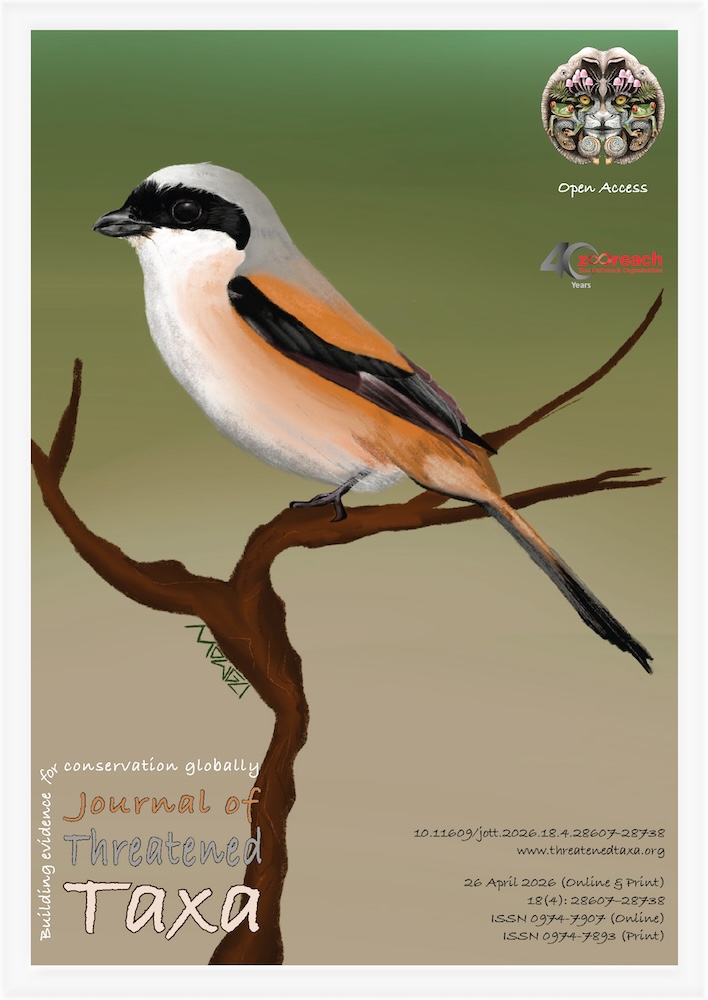
Published
Issue
Section
License
Copyright (c) 2026 R.K. Lodhi, N.P. Gour, S. Shakya, A. Jain, R.K. Gurjwar, R.J. Rao

This work is licensed under a Creative Commons Attribution 4.0 International License.
Authors own the copyright to the articles published in JoTT. This is indicated explicitly in each publication. The authors grant permission to the publisher Wildlife Information Liaison Development (WILD) Society to publish the article in the Journal of Threatened Taxa. The authors recognize WILD as the original publisher, and to sell hard copies of the Journal and article to any buyer. JoTT is registered under the Creative Commons Attribution 4.0 International License (CC BY), which allows authors to retain copyright ownership. Under this license the authors allow anyone to download, cite, use the data, modify, reprint, copy and distribute provided the authors and source of publication are credited through appropriate citations (e.g., Son et al. (2016). Bats (Mammalia: Chiroptera) of the southeastern Truong Son Mountains, Quang Ngai Province, Vietnam. Journal of Threatened Taxa 8(7): 8953–8969. https://doi.org/10.11609/jott.2785.8.7.8953-8969). Users of the data do not require specific permission from the authors or the publisher.