
Smooth-Coated Otter (Mammalia: Carnivora: Mustelidae) observation near a community reservoir in Bannerghatta National Park
DOI:
https://doi.org/10.11609/jott.9816.18.3.28540-28545Keywords:
Freshwater ecosystems, human-wildlife interactions, Karnataka, new record, observation, species distribution, otter conservationAbstract
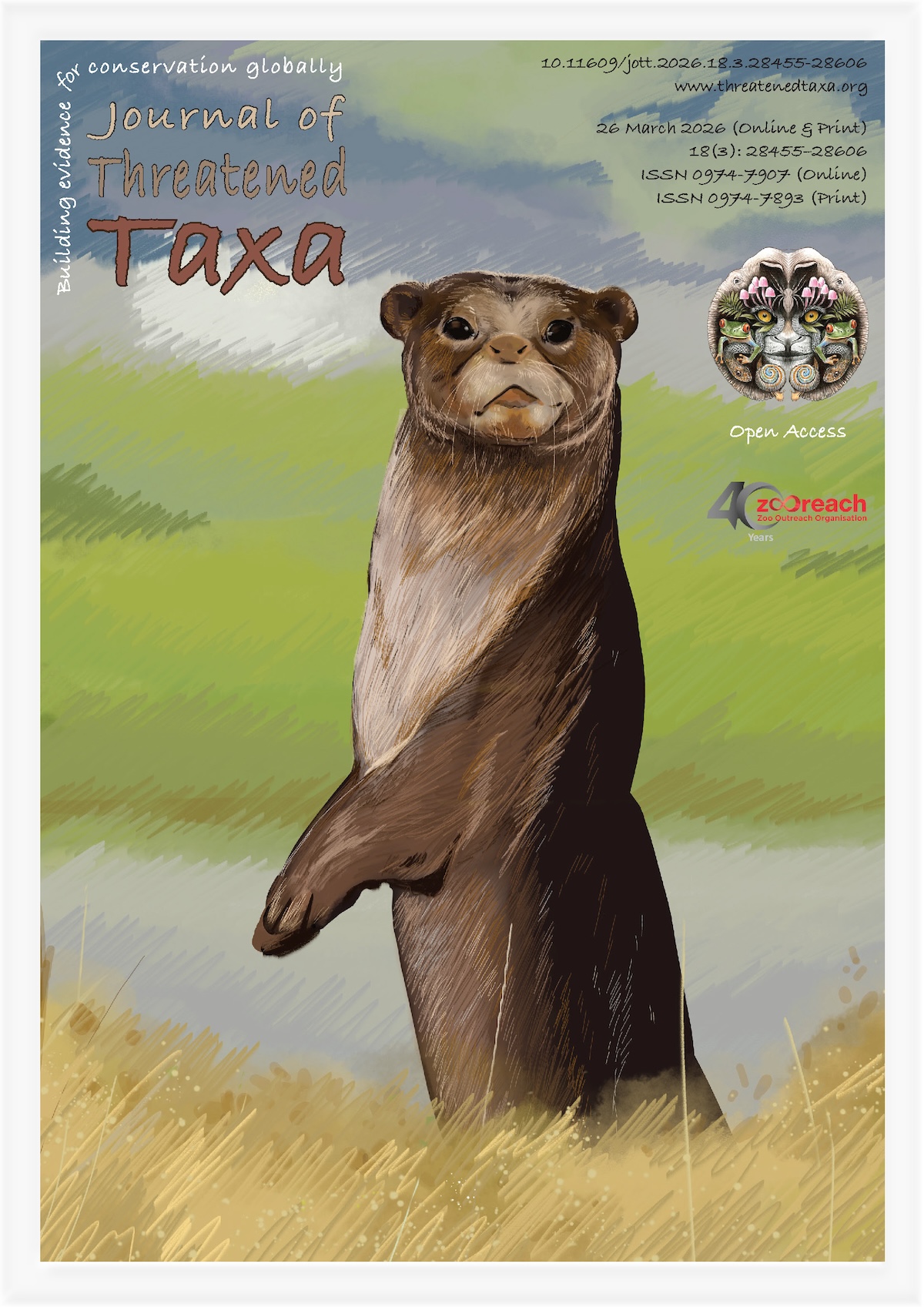
The Smooth-coated Otter Lutrogale perspicillata has not previously been documented from Bannerghatta National Park (BNP), southern India and this study confirms its presence from the landscape. A 10-day reconnaissance survey (from 17–26 October 2024) was conducted around the Chikkondanahalli Reservoir, which is located between BNP and the village of Chikkondanahalli (Karnataka) utilizing perimeter walks and community interviews. We gathered data and signs of otter presence and activity, such as spraints, tracks, and feeding remains. On the seventh day of the survey, a direct observation of a group of four otters was made, marking the first recorded sighting in the park. Additional evidence, including fresh spraints and track marks, confirmed otter presence. However, the survey also identified several anthropogenic threats, such as fishing, cattle grazing, and pollution, which may impact the quality of otter habitats and their long-term survival in the area. The results suggest that otters may use reservoirs like Chikkondanahalli as an important habitat with potential movement between water bodies. These findings highlight the need for further research to understand otter movement patterns and habitat preferences in the BNP landscape.
References
Arivoli, K. & K. Narasimmarajan (2021). First Record of an Elusive Predator: The Smooth-Coated Otter (Lutrogale perspicillata) from Vaduvoor Bird Sanctuary, Thiruvarur District, Tamil Nadu, Southern India. IUCN Otter Specialist Group Bulletin 38(2): 79–84.
Basnet, A., G. Prashant, Y.P. Timilsina & B.S. Bist (2020). Otter research in Asia: Trends, biases and future directions. Global Ecology and Conservation 24: e01391. https://doi.org/10.1016/j.gecco.2020.e01391
Baskaran, N., R.S. Sundarraj & R. Sanil (2022). Population, distribution and diet composition of Smooth-coated otter Lutrogale perspicillata Geoffroy, 1826 in Hosur and Dharmapuri forests divisions, India. Journal of Threatened Taxa 14(1): 20469–20477. https://doi.org/10.11609/jott.7477.14.1.20469-20477
Daily Pioneer (2017). Rare Smooth-coated Otter caught on camera in Karnataka. The Pioneer. Electronic version. Accessed on 15.xii.2024.
de Silva, P.K., W.A. Khan, B. Kanchanasaka, R.I. Lubis, M.M. Feeroz & O.F. Al-Sheikhly (2015). Lutrogale perspicillata. The IUCN Red List of Threatened Species. e.T12427A21934884. https://doi.org/10.2305/IUCN.UK.2015-2.RLTS.T12427A21934884.en
Duplaix, N. & M. Savage (2018). Report on The Global Otter Conservation Strategy. IUCN SSC Otter Specialist Group, Salem, Oregon, USA.
Gubbi, S., A.M. Menon, S. Suthar & H.C. Poornesha (2021). Report on Variation in leopard density and abundance: Multi-year study in Cauvery Wildlife Sanctuary. Nature Conservation Foundation, Mysore and Holématthi Nature Foundation, Bengaluru, India.
Jain, V. & K.K. Karanth (2023). Living alongside otters: examining human-otter interactions and attitudes towards otters in Central India for conservation in shared landscapes. Biodiversity and Conservation 32: 3001–3020. https://doi.org/10.1007/s10531-023-02640-9
Kamjing, A., D. Ngoprasert, R. Steinmetz, W. Chutipong, T. Savini & G.A. Gale (2017). Determinants of smooth-coated otter occupancy in a rapidly urbanizing coastal landscape in Southeast Asia. Mammalian Biology 87: 168–175. https://doi.org/10.1016/j.mambio.2017.08.006
Karikalan, V. (2013). Wildlife Management Plan for Bannerghatta National Park, 2013–14 to 2017–18. Karnataka Forest Department.
Krishnan, A., S. Panwar, A. Gayathri, S. Phalke & D.A. Venkateshaiah (2016). A Badger in Bannerghatta: an opportunistic record of the Ratel Mellivora capensis (Schreber, 1776) (Mammalia: Carnivora: Mustelidae) from Karnataka, India. Journal of Threatened Taxa 8(5): 8820–8823. https://doi.org/10.11609/jott.2587.8.5.8820-8823
Roos, A., A. Loy, P. de Silva, P. Hajkova & B. Zemanová (2015). Lutra lutra. The IUCN Red List of Threatened Species 2015.
Samad, K.S.A., S. Santhosh & B.B. Hosetti (2020). Assessment of Population of Smooth-Coated Otters Lutrogale perspicillata in Tungabhadra Otter Conservation Reserve (TOCR), North Karnataka, India. IUCN Otter Specialist Group Bulletin 37(4): 181–190.
Trivedi, K. & M. Variya (2023). Interactions between Fishermen and Smooth-Coated Otters (Lutrogale perspicillata) in the Tapti river of Surat District: A Case Study on Conflict Mitigation. IUCN Otter Specialist Group Bulletin 40(2): 64–71.
Varma, S., V.D. Anand, S.P. Gopalakrishna, K.G. Avinash & M.S. Nishant (2009). Ecology, conservation and management of the Asian elephant in Bannerghatta National Park, southern India. A Rocha India/ANCF: Asian Elephant Ecology and Conservation Reference Series 1: 13–52.
Published
Issue
Section
License
Copyright (c) 2026 Amrita Nair, Avinash Krishnan

This work is licensed under a Creative Commons Attribution 4.0 International License.
Authors own the copyright to the articles published in JoTT. This is indicated explicitly in each publication. The authors grant permission to the publisher Wildlife Information Liaison Development (WILD) Society to publish the article in the Journal of Threatened Taxa. The authors recognize WILD as the original publisher, and to sell hard copies of the Journal and article to any buyer. JoTT is registered under the Creative Commons Attribution 4.0 International License (CC BY), which allows authors to retain copyright ownership. Under this license the authors allow anyone to download, cite, use the data, modify, reprint, copy and distribute provided the authors and source of publication are credited through appropriate citations (e.g., Son et al. (2016). Bats (Mammalia: Chiroptera) of the southeastern Truong Son Mountains, Quang Ngai Province, Vietnam. Journal of Threatened Taxa 8(7): 8953–8969. https://doi.org/10.11609/jott.2785.8.7.8953-8969). Users of the data do not require specific permission from the authors or the publisher.