
A preliminary investigation on wing morphology, flight patterns, and flight heights of selected odonates
DOI:
https://doi.org/10.11609/jott.9445.17.11.27854-27862Keywords:
Aspect ratio, damselflies, dragonflies, Epiprocta, flight behaviour, geometric morphometrics, Nodal Index, Pterostigmatal Index, wing shape, wing venation, ZygopteraAbstract
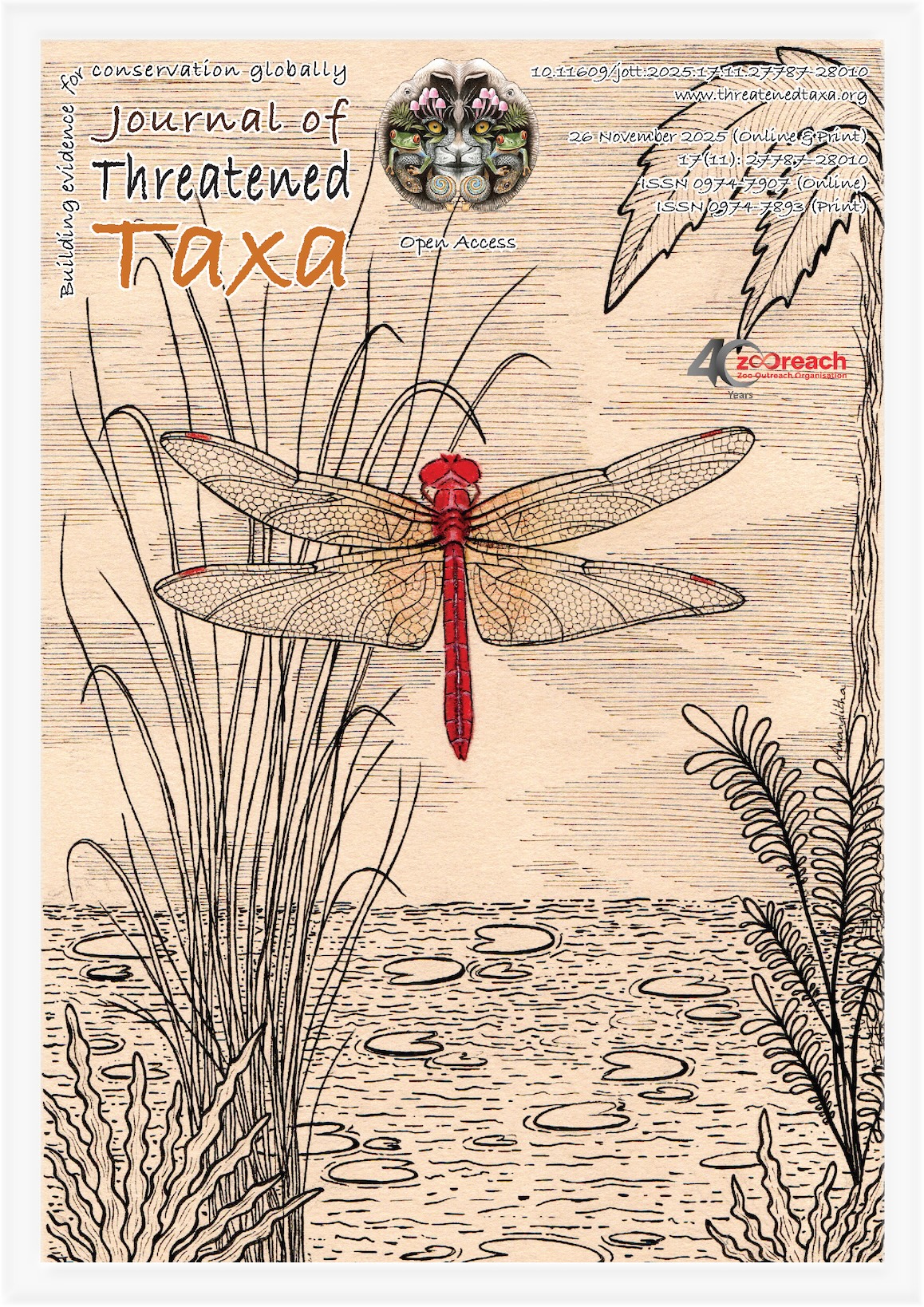
Wing shape and its individual structural components are a major contributor to the flight performance of odonates. Two essential components of wing structure are the nodus and the pterostigma. Our study showed that the position of the nodus (expressed as the nodal index) in the forewings and hindwings of dragonflies show subtle, but functionally important differences, whereas on a broader scale, dragonflies and damselflies show characteristic differences in accordance with their specific flight requirements. The position of the pterostigma expressed as the pterostigmatal index was observed to be optimized close to the wing tip across all odonates and unlike the nodus, there were no characteristic differences between dragonflies and damselflies in this regard. In addition to describing wing shape using aspect ratio, our study presents a geometric morphometric analysis of wing shape across flying and perching behaviour and across flight heights of odonates. It was found that wing shape does not significantly differ between fliers and perchers. However, certain species namely Crocothemis servilia, Tholymis tillarga, and Gynacantha bayadera showed notable deviations in wing shape. These deviations indicate that the dichotomous classification of odonates into perchers and fliers is too broad, possibly overlooking the nuanced flight patterns adopted by these insects. On the other hand, a significant association was found between wing shape and flight heights of odonates. These results suggest that behavioural factors may influence odonate wing shape, while also highlighting the importance of wing shape in flight efficiency. Consequently, the flight performance of biomimetic devices modelled after odonate flight, may be enhanced by optimizing wing shape in accordance with the heights above ground at which these devices are intended to operate.
References
Anon. (2024). Weather and Climatology of Telangana. Telangana State Development Planning Society & Directorate of Economics and Statistics, Planning Department, Government of Telangana, Hyderabad, 246 pp.
Andrew, R.J., K.A. Subramanian & A.D. Tiple (2008). A Handbook on Common Odonates of Central India. Hislop College, Nagpur, 54 pp.
Arnaud, S., K. Kari, C. Lenin, M. André, P. Olga, P. Justin, B. David, T. Nedim & S. Robby (2022). Odonata trophic ecology: from hunting behaviour to cross-ecosystem impact, pp. 219–232. In: Córdoba-Aguilar, A., C. Beatty & J.T. Bried (eds.). Dragonflies and Damselflies: Model Organisms for Ecological and Evolutionary Research (2nd edition). Oxford University Press eBooks, Oxford. https://doi.org/10.1093/oso/9780192898623.003.0016
Betts, C.R. & R.J. Wootton (1988). Wing shape and flight behaviour in butterflies (Lepidoptera: Papilionoidea and Hesperioidea): A preliminary analysis. Journal of Experimental Biology 138(1): 271–288. https://doi.org/10.1242/jeb.138.1.271
Bhat, S.S., J. Zhao. J. Sheridan, K. Hourigan & M.C. Thompson (2019). Aspect ratio studies on insect wings. Physics of Fluids 31(12): 121301. https://doi.org/10.1063/1.5129191
Bomphrey, R.J., T. Nakata, P. Henningsson & H.-T. Lin (2016). Flight of the dragonflies and damselflies. Philosophical Transactions of the Royal Society B: Biological Sciences 371(1704): 20150389. https://doi.org/10.1098/rstb.2015.0389
Clausnitzer, V. (1999). Dragonfly (Odonata) records of Kakamega Forest, Western Kenya, with notes on the ecology of rain forest species. Journal of East African Natural History 88(1): 17–23. https://doi.org/10.2982/0012-8317(1999)88
Corbet, P.S. (1980). Biology of Odonata. Annual Review of Entomology 25(1): 189–217. https://doi.org/10.1146/annurev.en.25.010180.001201
Corbet, P.S. & M.L. May (2008). Fliers and perchers among Odonata: Dichotomy or multidimensional continuum? A provisional reappraisal. International Journal of Odonatology 11(2): 155–171. https://doi.org/10.1080/13887890.2008.9748320
Engels, T., D. Kolomenskiy, K. Schneider, F.O. Lehmann & J. Sesterhenn (2016). Bumblebee flight in heavy turbulence. Physical Review Letters 116: 028103. https://doi.org/10.1103/PhysRevLett.116.028103
Ennos, A.R. (1988). The importance of torsion in the design of insect wings. Journal of Experimental Biology 140(1): 137–160. https://doi.org/10.1242/jeb.140.1.137
Ennos, A.R. (1989). The effect of size on the optimal shapes of gliding insects and seeds. Journal of Zoology 219(1): 61–69. https://doi.org/10.1111/j.1469-7998.1989.tb02565.x
Fauziyah, S., C. Alam, R.C.H. Soesilohadi, B. Retnoaji & P. Alam (2014). Morphological and mechanical characterisation of the hindwing nodus from the Libellulidae family of dragonfly (Indonesia). Arthropod Structure & Development 43(5): 415–422. https://doi.org/10.1016/j.asd.2014.06.004
Fu, J., X. Liu, W. Shyy & H. Qiu (2018). Effects of flexibility and aspect ratio on the aerodynamic performance of flapping wings. Bioinspiration & Biomimetics 13(3): 036001. https://doi.org/10.1088/1748-3190/aaaac1
Hassall, C. (2015). Strong geographical variation in wing aspect ratio of a damselfly, Calopteryx maculata (Odonata: Zygoptera). PeerJ 3: e1219. https://doi.org/10.7717/peerj.1219
Johansson, F., M. Soderquist & F. Bokma (2009). Insect wing shape evolution: Independent effects of migratory and mate guarding flight on dragonfly wings. Biological Journal of the Linnean Society 97(2): 362–372. https://doi.org/10.1111/j.1095-8312.2009.01211.x
Khaheshi, A., H.T Tramsen, S.N Gorb & H. Rajabi (2021a). Against the wind: A load-bearing, yet durable, kite inspired by insect wings. Materials & Design 198: 109354. https://doi.org/10.1016/j.matdes.2020.109354
Khaheshi, A., S.N Gorb & H. Rajabi (2021b). Spiky-joint: a bioinspired solution to combine mobility and support. Applied Physics A 127: 1–7. https://doi.org/10.1007/s00339-021-04310-5
Khaheshi, A., S. Gorb & H. Rajabi (2021c). Triple Stiffness: A Bioinspired Strategy to Combine Load‐Bearing, Durability, and Impact‐Resistance. Advanced Science 8(11): 2004338. https://doi.org/10.1002/advs.202004338
Klingenberg, C.P. (2011). MorphoJ: an integrated software package for geometric morphometrics. Molecular Ecology Resources 11: 353–357.
Li, H. & M.R.A. Nabawy (2022). Wing planform effect on the aerodynamics of insect wings. Insects 13(5): Article 5. https://doi.org/10.3390/insects13050459
Luo, G. & M. Sun (2005). The effects of corrugation and wing planform on the aerodynamic force production of sweeping model insect wings. Acta Mechanica Sinica 21(6): 531–541. https://doi.org/10.1007/s10409-005-0072-4
MacLeod, N., B. Price & Z. Stevens (2022). What you sample is what you get: Ecomorphological variation in Trithemis (Odonata, Libellulidae) dragonfly wings reconsidered. BMC Ecology and Evolution 22(1): 43. https://doi.org/10.1186/s12862-022-01978-y
May, M.L. (1981). Allometric analysis of body and wing dimensions of male Anisoptera. Odonatologica 10(4): 279–291.
May, M.L. (2019). Odonata: Who they are and what they have done for us lately: Classification and ecosystem services of dragonflies. Insects 10(3): 62. https://doi.org/10.3390/insects10030062
Miller, P.L. (2007). Dragonflies of the Madurai Kamaraj Universtiy Campus (Tamil Nadu, India), pp. 273–322. In: Tyagi, B.K. (ed.). Odonata: Biology of Dragonflies. Scientific Publishers, India, pp. 284–317.
Miller, P.L. & A.K. Miller (1985). Rates of oviposition and some other aspects of reproductive behaviour in Tholymis tillarga (Fabricius) in Kenya (Anisoptera: Libellulidae). Odonatologica 14(4): 287–299.
Mitra, T.R. (1994). Observations on the habits and habitats of adult dragonflies of Eastern India with special reference to the fauna of West Bengal. Records of the Zoological Survey of India Occasional Paper No. 166: 1–40.
Mitra, T.R. (2005). Evolutionary adaptations in morphology and ecology of Tholymis tillarga (Fabricius) and Bradinopyga geminata (Rambur) (Insecta: Odonata). Records of the Zoological Survey of India 104: 101–104. https://doi.org/10.26515/rzsi/v104/i1-2/2005/159323
Mitra, T.R. (2006). Handbook on Common Indian Dragonflies (Insecta: Odonata): For Nature Lovers and Conservationists. Zoological Survey of India, Kolkata, 136 pp.
Mitra, T.R., M.L. De & I.J. Gupta (1998). Ecological reconnaissance of adult Odonata (Insecta) of eastern India. Records of the Zoological Survey of India 96(1–4):237–241.
Norberg, R.Å. (1972). The pterostigma of insect wings an inertial regulator of wing pitch. Journal of Comparative Physiology 81: 9–22. https://doi.org/10.1007/BF00693547
Parr, M.J. (1983). An analysis of territoriality in libellulid dragonflies (Anisoptera: Libellulidae). Odonatologica 12(1): 39–57.
Paulson, D., M. Schorr, J. Abbott, C. Bota-Sierra, C. Deliry, K.-D. Dijkstra & F. Lozano (Coordinators) (2024). World Odonata List. Odonata Central, University of Alabama. https://www.odonatacentral.org/app/#/wol/. Accessed on 07.vii.2024
Phillips, N., K. Knowles & R. Bomphrey (2015). The effect of aspect ratio on the leading-edge vortex over an insect-like flapping wing. Bioinspiration & Biomimetics 10: 056020. https://doi.org/10.1088/1748-3190/10/5/056020
Rajabi, H., N. Ghoroubi, K. Stamm, E. Appel & S.N. Gorb (2017). Dragonfly wing nodus: A one-way hinge contributing to the asymmetric wing deformation. Acta Biomaterialia 60: 330–338. https://doi.org/10.1016/j.actbio.2017.07.034
Rajabi, H. & S.N. Gorb (2020). How do dragonfly wings work? A brief guide to functional roles of wing structural components. International Journal of Odonatology 23(1): 23–30. https://doi.org/10.1080/13887890.2019.1677515
Rajabi, H., K. Stamm, E. Appel & S.N. Gorb (2018). Micro-morphological adaptations of the wing nodus to flight behaviour in four dragonfly species from the family Libellulidae (Odonata: Anisoptera). Arthropod Structure & Development 47(4): 442–448. https://doi.org/10.1016/j.asd.2018.01.003
Sakagami, S.F., H. Ubukata, M. Iga, M. & M.J. Toda (1974). Observations on the behavior of some Odonata in the Bonin Islands, with considerations on the evolution of reproductive behavior in Libellulidae. Journal of the Faculty of Science Hokkaido University Ser. VI Zoology 19(3): 722–757.
Schneider, C., W. Rasband & K. Eliceiri (2012). NIH Image to ImageJ: 25 years of image analysis. Nature Methods 9: 671–675. https://doi.org/10.1038/nmeth.2089
Shahzad, A., F.B. Tian, J. Young & J. Lai (2016). Effects of wing shape, aspect ratio and deviation angle on aerodynamic performance of flapping wings in hover. Physics of Fluids 28(11). https://doi.org/10.1063/1.4964928
Sharma, M. & B. Oli (2022). Odonates (Insecta: Odonata) associated with rice ecosystems in Sunwal municipality, central Nepal. Journal of Natural History Museum 32: 35–48. https://doi.org/10.3126/jnhm.v32i1.49951
Subramanian, K.A. (2012). Foraging and breeding behaviour of Peninsular Indian Odonata, pp. 158–171. In: Ananthakrishnan, T.N. & K.G. Sivaramakrishnan (eds.). Dynamics Of Insect Behavior. Scientific Publishers, Rajasthan, India.
Subramanian, K.A. and R. Babu (2024). Fauna of India Checklist: Arthropoda: Insecta: Odonata. Version 1.0. Zoological Survey of India. https://doi.org/10.26515/Fauna/1/2023/Arthropoda: Insecta:Odonata
Subramanian, K.A., S. Ali & T.V. Ramchandra (2008). Odonata as indicators of riparian ecosystem health a case study from south western Karnataka, India. Fraseria (NS) 7: 83–95.
Tarrís-Samaniego, S., J. Muzón & M.S. Iglesias (2023). When size and shape matter: morphometric characterization of two sympatric dragonflies of the genus Perithemis (Odonata: Libellulidae). Anais Da Academia Brasileira de Ciências 95: e20220583. https://doi.org/10.1590/0001-3765202320220583
Tatsuta, H., K.H. Takahashi & Y. Sakamaki (2018). Geometric morphometrics in entomology: basics and applications. Entomological Science 21(2): 164–184. https://doi.org/10.1111/ens.12293
Wakeling, J.M. & C. Ellington (1997a). Dragonfly Flight: I. Gliding flight and steady-state aerodynamic forces. The Journal of Experimental Biology 200: 543–556. https://doi.org/10.1242/jeb.200.3.543
Wakeling, J.M. & C. Ellington (1997b). Dragonfly Flight: II. Velocities, accelerations and kinematics of flapping flight. Journal of Experimental Biology 200: 557–582. https://doi.org/10.1242/jeb.200.3.557
Wakeling, J.M. & C. Ellington (1997c). Dragonfly Flight: III. Lift and power requirements. The Journal of Experimental Biology 200: 583–600. https://doi.org/10.1242/jeb.200.3.583
Wakeling, J.M. (1997). Odonatan wing and body morphologies. Odonatologica 26(1): 35–52.
Webster, M. & H.D. Sheets (2010). A practical introduction to landmark-based geometric morphometrics. The Paleontological Society Papers 16: 163–188. https://doi.org/10.1017/S1089332600001868
Wootton, R.J. (1991). The functional morphology of the wings of Odonata. Advances in Odonatology 5(1): 153–169.
Wootton, R.J. & D.J.S. Newman (2008). Evolution, diversification, and mechanics of dragonfly wings. pp. 261–274. In: Córdoba-Aguilar, A. (ed.). Dragonflies & Damselflies: Model Organisms for Ecological and Evolutionary Research. Oxford Academy, Oxford. Online edition. Accessed on 08.ix.2024. https://doi.org/10.1093/acprof:oso/9780199230693.003.0020
Wootton, R. (2020). Dragonfly flight: Morphology, performance and behaviour. International Journal of Odonatology 23(1): 31–39. https://doi.org/10.1080/13887890.2019.1687991
Xi, O., S. Zhang, J. Li, H. Hu & M. Bai (2024). Geometric morphometrics and genetic diversity analysis of Chalcidoidea (Diglyphus and Pachyneuron) at various elevations. Insects 15(7): Article 7. https://doi.org/10.3390/insects15070497
Published
Versions
- 27-11-2025 (2)
- 26-11-2025 (1)
Issue
Section
License
Copyright (c) 2025 Ananditha Pascal, Chelmala Srinivasulu

This work is licensed under a Creative Commons Attribution 4.0 International License.
Authors own the copyright to the articles published in JoTT. This is indicated explicitly in each publication. The authors grant permission to the publisher Wildlife Information Liaison Development (WILD) Society to publish the article in the Journal of Threatened Taxa. The authors recognize WILD as the original publisher, and to sell hard copies of the Journal and article to any buyer. JoTT is registered under the Creative Commons Attribution 4.0 International License (CC BY), which allows authors to retain copyright ownership. Under this license the authors allow anyone to download, cite, use the data, modify, reprint, copy and distribute provided the authors and source of publication are credited through appropriate citations (e.g., Son et al. (2016). Bats (Mammalia: Chiroptera) of the southeastern Truong Son Mountains, Quang Ngai Province, Vietnam. Journal of Threatened Taxa 8(7): 8953–8969. https://doi.org/10.11609/jott.2785.8.7.8953-8969). Users of the data do not require specific permission from the authors or the publisher.