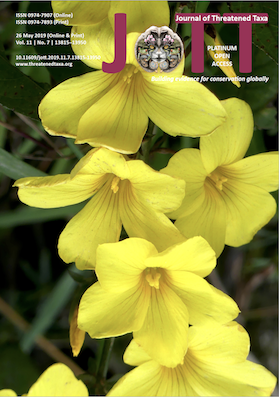
Winter season bloomer Hairy Bergenia Bergenia ciliata (Haw.) Sternb. (Saxifragales: Saxifragaceae), an important winter forage for diverse insect groups
DOI:
https://doi.org/10.11609/jott.4268.11.7.13937-13940Keywords:
Eastern Himalaya, insect diversity, pollination managementAbstract
Pollinators can play an important role in production improvement in organic farming. It is, therefore, essential to ensure their year-round availability, particularly in winter season in Sikkim Himalaya. Thus, attempts were made to explore resources which could support and provide switching over platforms to pollinators during the winter season. Among the few observed forage species, Bergenia ciliata was found to be an important species that supports a diverse group of pollinators by providing the necessary forage. Therefore, B. ciliata is to be protected and managed to provide forage to pollinator insects during winter season.
References
Gaira, K.S., R.S. Rawal & K.K. Singh (2016). Variations in pollinator density and impacts on large cardamom (Amomum subulatum Roxb.) crop yield in Sikkim Himalaya, India. Journal of Asia-Pacific Biodiversity 9(1): 17–21.
Gallai, N., J.M. Salles, J. Settele & B.E. Vaissiere (2009). Economic valuation of the vulnerability of world agriculture confronted with pollinator decline. Ecology and Economics 68(3): 810–821.
Garibaldi, L.A., L.G. Carvalheiro, B.E. Vaissière, et al. (2016). Mutually beneficial pollinator diversity and crop yield outcomes in small and large farms. Science 351(6271): 388–391.
Kapkoti, B., R.K. Joshi & R.S. Rawal (2016a). Thistle (Cirsium verutum): An Important Forage for Pollinators in Kumaun, West Himalaya. National Academy Science Letters 39(5): 395–399; https://doi.org/10.1007/s40009-016-0501-x
Kapkoti, B., R.S. Rawal & R.K. Joshi (2016b). Insect Pollinators of Brassica campestris in Kumaun, West Himalaya: Influence of Crop Composition, Altitude and Flowering Phenology. National Academy Science Letters 39(5): 389–394. https://doi.org/10.1007/s40009-016-0500-y
Klein, A.M., I. Steffan-Dewenter & T. Tscharntke (2003). Fruit set of highland coffee increases with the diversity of pollinating bees. Proceedings of the Royal Society B 270: 955–961.
Kumar, P.S. (2012). Impact of climate change and adaptation measures in dairy sector of Sikkim, p219–231. In: Arrawatia, M.L. & S. Tambe (eds.). Biodiversity of Sikkim: Exploring and Conserving a Global Hotspot. Gangtok, Sikkim: Information and Public Relations Department, Government of Sikkim.
Larson, B.M.H., P. Kevan & D.W. Inouye (2001). Flies and flowers: taxonomic diversity of antho-philes and pollinators. Canadian journal of Entomology 133: 439–465.
Myers, N., R.A. Mittermeier, C.G. Mittermeier, G.A.B. da Fonseca & J. Kent (2000). Biodiversity hotspots for conserÂvation priorities. Nature 403: 853–858
Pandey, A., H.K. Badola, S. Rai & S.P. Singh (2018). Timberline structure and woody taxa regeneration towards treeline along latitudinal gradients in Khangchendzonga National Park, Eastern Himalaya. PLoS ONE 13(11): e0207762
Pratap, U., T. Pratap, H.K. Sharma, P. Phartiyal, A. Marma, N.B. Tamang, T. Ken & M.S. Munawar (2012). Value of insect pollinators to Himalayan agricultural economics, Kathmandu: ICIMOD.
Rai, L.K., P. Prasad & E. Sharma (2000). Conservation threats to some important medicinal plants of the Sikkim Himalaya. Biological Conservation 93: 27–33.
Sanghamitra, S., T.M.K. Maiti, J.R. Gayen, P. Basudeb, M. Pal & B.P. Saha (2001). Antibacterial activity of Bergenia ciliata rhizome. Fitoterapia 72: 550–552.
SBAP (2012). Sikkim Biodiversity Action Plan. Gangtok, Sikkim: Sikkim Biodiversity Conservation and Forest Management Project (SBFP), and Forest Environment and Wildlife Management Department, Government of Sikkim.
Shrestha, I. & N. Joshi (1993). Medicinal plants of the Lele village of Lalitpur District, Nepal. International Journal of Pharmacognosy 31(2): 130–134.
Sharma, G., U. Partap, E. Sharma, G. Rasul & R.K. Awasthe (2016). Agrobiodiversity in the Sikkim Himalaya: Sociocultural significance, status, practices, and challenges. ICIMOD Working Paper 2016/5 Kathmandu: ICIMOD
SPOF (2015). State Policy on Organic Farming, Government of Sikkim. Sikkim Organic Mission, FS&AD and H&CCD Departments Government of Sikkim, Krishi Bhawan Tadong, East Sikkim.
Ssymank, A. & C. Kearns (2009). Flies - Pollinators on two wings. Caring for Pollinators: safeguarding agrobiodiversity and wild plant diversity. Bundesamt für Naturschutz, German Federal Agency for Nature Conservation, Bonn, 39–52pp.
Sundriyal, R.C., S.C. Rai, E. Sharma & Y.K. Rai (1994). Hill agroforestry systems in south Sikkim, India. Agroforestry Systems 26: 215–235.
Published
Issue
Section
License
Authors own the copyright to the articles published in JoTT. This is indicated explicitly in each publication. The authors grant permission to the publisher Wildlife Information Liaison Development (WILD) Society to publish the article in the Journal of Threatened Taxa. The authors recognize WILD as the original publisher, and to sell hard copies of the Journal and article to any buyer. JoTT is registered under the Creative Commons Attribution 4.0 International License (CC BY), which allows authors to retain copyright ownership. Under this license the authors allow anyone to download, cite, use the data, modify, reprint, copy and distribute provided the authors and source of publication are credited through appropriate citations (e.g., Son et al. (2016). Bats (Mammalia: Chiroptera) of the southeastern Truong Son Mountains, Quang Ngai Province, Vietnam. Journal of Threatened Taxa 8(7): 8953–8969. https://doi.org/10.11609/jott.2785.8.7.8953-8969). Users of the data do not require specific permission from the authors or the publisher.